
Lumber Sizes Chart — Nominal vs Actual Dimensions
A nominal 2×4 does not measure exactly 2 by 4 inches. Use this chart to compare common US softwood lumber sizes with their standard dressed dimensions in inches and millimeters.
Nominal vs Actual Lumber Sizes Chart
The following tables show nominal sizes and minimum dressed dry dimensions according to the US Department of Commerce’s American Softwood Lumber Standard, PS 20-25.
Inch dimensions are the units of record under PS 20-25. Metric values are provided for information and comparison.
These dimensions apply at the time of manufacture. Actual measurements may vary with moisture content, manufacturing tolerances, and subsequent processing.
1× Lumber — Common Board Sizes
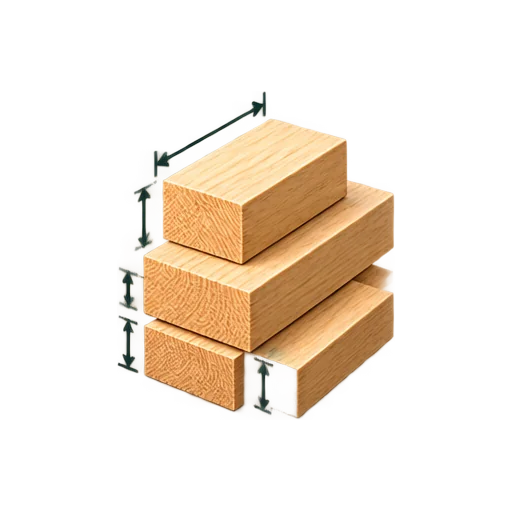
| Nominal Size | Dressed Dry (in) | Dressed Dry (mm) |
|---|---|---|
| 1×2 | ¾ × 1½ | 19.1 × 38.1 |
| 1×3 | ¾ × 2½ | 19.1 × 63.5 |
| 1×4 | ¾ × 3½ | 19.1 × 88.9 |
| 1×6 | ¾ × 5½ | 19.1 × 139.7 |
| 1×8 | ¾ × 7¼ | 19.1 × 184.2 |
| 1×10 | ¾ × 9¼ | 19.1 × 235.0 |
| 1×12 | ¾ × 11¼ | 19.1 × 285.8 |
2× Lumber — Common Dimension Sizes
| Nominal Size | Dressed Dry (in) | Dressed Dry (mm) |
|---|---|---|
| 2×2 | 1½ × 1½ | 38.1 × 38.1 |
| 2×3 | 1½ × 2½ | 38.1 × 63.5 |
| 2×4 | 1½ × 3½ | 38.1 × 88.9 |
| 2×6 | 1½ × 5½ | 38.1 × 139.7 |
| 2×8 | 1½ × 7¼ | 38.1 × 184.2 |
| 2×10 | 1½ × 9¼ | 38.1 × 235.0 |
| 2×12 | 1½ × 11¼ | 38.1 × 285.8 |
Source: NIST — American Softwood Lumber Standard PS 20-25, Table 3.
The tables describe common standard lumber categories, not every wood product or specialty profile.
What Do Nominal and Actual Dimensions Mean?
Nominal size is the name used to identify a lumber size category. For example, 2×4 describes a nominal board size.
Actual size refers to the physical dimensions of the finished piece.
During manufacturing, lumber may be dried and surfaced to create more consistent dimensions and smoother faces. As a result, dressed lumber is generally smaller than its nominal size.
For example:
- Nominal 2×4: 2 × 4 inches.
- Standard minimum dressed dry size: 1½ × 3½ inches.
- Metric equivalent: 38.1 × 88.9 mm.
The nominal dimensions are a product designation, not a promise of the finished board’s physical dimensions.
Why Is a 2×4 Actually 1½ × 3½ Inches?
The difference comes from lumber processing and standardized sizing conventions.
Rough-sawn lumber is processed to obtain the required finished surfaces and dimensions. Drying can also cause wood to shrink.
The American Softwood Lumber Standard defines minimum dressed dimensions for common lumber categories so buyers and manufacturers have a consistent reference.
Standard sizes are measured at manufacture. Wood can continue to expand or shrink as its moisture content changes.
Dry vs Green Lumber Dimensions
The standard distinguishes dry lumber from green lumber.
For softwood lumber less than 5 inches in nominal thickness:
- Dry lumber: moisture content of 19% or less.
- Green lumber: moisture content above 19%.
Green dressed lumber generally has larger minimum dimensions to allow for changes during drying.
For example, a nominal 2×4 has these minimum dressed sizes:
| Condition | Dimensions (in) |
|---|---|
| Dry | 1½ × 3½ |
| Green | 1 9/16 × 3 9/16 |
Certain species, including Redwood, Western Red Cedar, and Northern White Cedar, have special provisions for green dressed sizes.
Do not assume that every piece of lumber has exactly the dimensions shown in a reference chart. Measure the material when precise fit is important.
Rough-Sawn vs Surfaced Lumber
Rough-sawn lumber retains surfaces from the sawing process and may be supplied in different dimensions from surfaced lumber.
Surfaced lumber has been dressed to meet specified finished-size requirements.
A rough board labeled 2×4 should not automatically be assumed to measure exactly 2 × 4 inches. Rough sizes depend on manufacturing specifications and applicable grading rules.
For precise woodworking projects, confirm the dimensions of the material being supplied.
Lumber Dimensions and Board Feet
Nominal and actual dimensions can produce different board-foot calculations.
Consider an 8-foot-long nominal 2×4.
Using nominal dimensions:
Board Feet = (2 × 4 × 8) / 12 = 5.33 BF
Using standard dressed dry dimensions:
Board Feet = (1.5 × 3.5 × 8) / 12 = 3.50 BF
The first calculation uses nominal dimensions commonly associated with lumber tally conventions. The second expresses the geometric volume of a piece with the stated dressed dimensions.
These results should not be treated as interchangeable when comparing commercial lumber quantities and physical volume.
Use the Board Foot Calculator to calculate volume from your chosen dimensions.
When Should You Use Actual Dimensions?
Use actual measured dimensions when determining:
- The physical space occupied by a board.
- The clearance required between pieces.
- Dimensions for a precise woodworking fit.
- Geometric wood volume.
Nominal dimensions are useful when identifying standard lumber products and interpreting commercial size descriptions.
For structural applications, physical dimensions alone are not enough. Lumber grade, species, span, loading, and applicable construction requirements also matter.
Frequently Asked Questions
What is the actual size of a 2×4?
The standard minimum dressed dry size is 1½ × 3½ inches (38.1 × 88.9 mm).
What is the actual size of a 2×6?
A standard dressed dry 2×6 measures at least 1½ × 5½ inches (38.1 × 139.7 mm) at the time of manufacture.
Why are lumber sizes smaller than their names?
Nominal dimensions are trade size designations. Finished dimensions are smaller because of lumber processing, including surfacing and drying.
Are lumber sizes the same everywhere?
No. The tables on this page describe US standard softwood lumber categories. Other countries, specialty products, engineered lumber, and hardwood products can use different sizing systems.
Are these exact dimensions for every board?
No. They represent standard minimum dressed dry sizes at manufacture. Individual measurements can vary, particularly as wood moisture content changes.
Does the same chart apply to hardwood lumber?
Not necessarily. Hardwood lumber often uses different thickness designations, grading rules, and commercial measurement conventions.
Can I use actual dimensions in a board foot calculation?
Yes. Actual dimensions produce a geometric volume based on the measurements supplied. However, commercial lumber tally may use a different nominal measurement basis.
Official Reference
American Softwood Lumber Standard — PS 20-25
US Department of Commerce, National Institute of Standards and Technology.
Effective January 2025. Relevant sections: Terminology, Measurement and Tally, Lumber Sizes, and Table 3.
Related Calculator
Board Foot Calculator
Calculate lumber volume using thickness, width, length, and quantity. Work with either nominal or measured dimensions.